

- By kelly
- August 11, 2025
- Logistics Guide
If you’re exploring efficient logistics between Asia and Europe, rail freight from China to Europe by train offers a compelling alternative to traditional sea and air transport.
Transit Times: Swift and CompetitiveCL
Rail journeys between China and Europe typically take 12–18 days, significantly faster than the 30–40 days required for maritime shipping. For instance, the Yiwu–London route covers around 12,000 km and completes in about 18 days, while the longer Yiwu–Madrid corridor—roughly 13,000 km—is completed in about 21 days.
Cost Advantages: Striking the Right Balance
Rail freight is more affordable than air transport and offers a faster option than sea shipping. This middle ground is especially cost-effective for time-sensitive cargo.
- According to SINO Shipping, the cost per 40′ container ranges from USD 5,000 to USD 5,300, offering savings over express air services.
- In broader terms, rail freight from China to Europe costs between one-sixth to one-eighth of air freight and takes only one-third of the time compared to sea transport.
Extensive Network & Robust Coverage
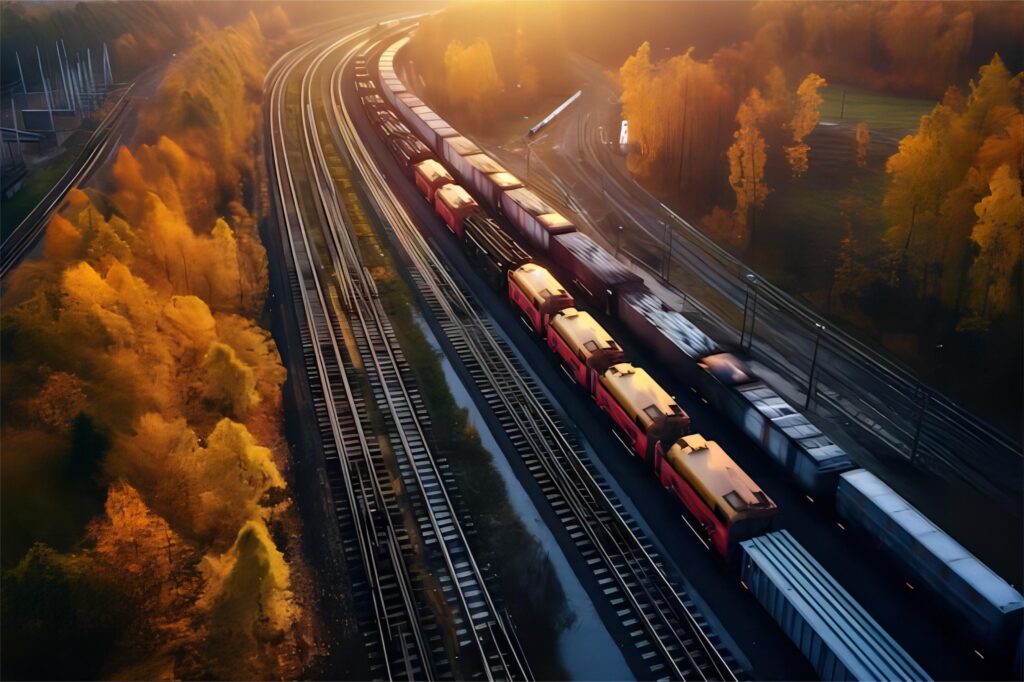
The China–Europe rail network, also known as the China–Europe Railway Express, has expanded rapidly:
- Over 17,000 annual trips were made by 2024, up from 1,700 in 2016.
- Today’s network reaches 227 cities in 25 European countries and over 100 in Asia, spanning more than 50,000 types of goods across 53 categories.
- Key routes link inland hubs like Chongqing to Duisburg—a major logistics center in Germany—via Kazakhstan, Russia, and Belarus.
Reliability, Sustainability, and Logistics Efficiency
- Consistency: Rail offers dependable schedules, unaffected by port congestion or sea delays.
- Green transportation: Rail emits approximately 30% less CO₂ than air freight, and significantly less than road haulage.
- Border efficiency: Even with breaks of gauge at borders, operations utilize bogie exchanges or transloading, ensuring minimal disruption.
Strategic Impact and Trade Growth
Global Trade Enhancement
- Rail freight is a competitive, reliable backbone for global logistics—especially vital during shipping disruptions.
- It fosters trade integration by linking inland regions to European markets, empowering SMEs and remote areas.
Belt and Road Initiative (BRI)
- As a core component of the BRI, these rail routes revitalize the modern Silk Road, projecting connectivity across Eurasia.
Why Choose “China to Europe by Train”?
| Advantage | Benefit |
|---|---|
| Faster transit | 12–21 days vs. 30–45 by sea |
| Cost-effective | Cheaper than air; competitive with sea in speed and budget |
| Sustainable | Lower carbon footprint than air and road transports |
| Extensive coverage | Hundreds of cities across multiple countries connected |
| Reliable operations | Fixed schedules and advanced logistics systems |
| Supports regional growth | Enhances trade for inland & SME regions |
Conclusion
China to Europe by train delivers a powerful logistics solution—blending speed, cost efficiency, environmental sustainability, and expansive network coverage. It’s reshaping global trade routes and powering the next wave of cross-border connectivity. If you’d like, I can help you draft additional sections such as specific routes, operational steps, or client case studies.
Get Your Rail Freight Quote Toda
Looking to ship China to Europe by train? At TJ China Freight, we provide fast, reliable, and cost-effective rail freight solutions tailored to your business needs. Whether you’re moving full container loads (FCL) or less-than-container loads (LCL), our team ensures smooth customs clearance, optimal routes, and transparent pricing.
FAQ – China to Europe by Train
1. What types of cargo are suitable for rail freight from China to Europe?
Rail is ideal for electronics, machinery, automotive parts, textiles, and even temperature-controlled goods. Fragile or high-value shipments also benefit from shorter transit times and reduced handling compared to sea freight.
2. Can I ship small volumes, or is rail only for full containers?
You can ship both FCL (Full Container Load) and LCL (Less than Container Load). LCL allows you to share space in a container, making rail affordable even for smaller shipments.
3. How secure is rail transport compared to sea freight?
Rail cargo is sealed and monitored through checkpoints along the route. Many trains use GPS tracking and security escorts in certain regions to ensure goods arrive safely.
4. Are there customs delays when crossing multiple countries?
While trains pass through several borders, customs clearance is streamlined through pre-arranged documents and digital declarations. Using an experienced forwarder like TJ China Freight minimizes the risk of delays.
5. How does rail freight handle different railway gauges?
At borders where track gauges differ, containers are either transloaded to a different train or railcars undergo a bogie exchange. This process is built into the transit schedule.
6. Is rail freight environmentally friendly?
Yes — trains emit significantly less CO₂ compared to air or road transport, making them a greener option for companies aiming to reduce their carbon footprint.